Abandonware Games: The Full Classic PC Archive, Catalogued by Company, Theme, and Year
Most abandonware pc games sites are a download link with a screenshot bolted on. This is the opposite: a catalog built around the record, not the installer. Every entry here documents a classic game's actual development history, who made it, what it changed about its genre, and whether a real, legal way to play it exists today, then leaves the file hosting to someone else entirely.
That distinction matters more than it sounds. A lot of abandonware games searches are really two different questions wearing one label: "what was this game, and is it worth knowing about," and "can I get a working copy of it." This archive only answers the first one directly, and treats the second honestly rather than pointing at a zip file and calling it settled.

An open card-catalog drawer of handwritten index cards beside a small stack of floppy disks.
- Catalog: 126 titles
- Read time: ~17 min
What a Classic Abandonware Games Archive Actually Needs to Get Right
Calling something abandonware is a shorthand, not a legal category, and treating it as settled fact is exactly how a catalog stops being trustworthy. Every entry in this archive gets one of three honest labels instead of a blanket assumption: an official re-release still sold by the original rights-holder, a legacy title with no current sale but a known owner, or a status genuinely unclear from the surviving record. Getting that distinction wrong in either direction, calling something abandoned when it's still sold, or implying clean legal standing when it isn't, is the fastest way an abandonware pc games resource loses the trust it needs to be useful.
It also means the "archive" part of the name is earned rather than decorative. Every write-up here is sourced from verifiable release history, real credited developers, and documented critical reception, cross-referenced against the original site's own historical game-entry listings where a record survives. Titles with thin or contradictory source material get a shorter, more cautious entry rather than a confident-sounding page built on guesses. A classic abandonware games archive that can't say "we don't actually know" about a handful of entries isn't more complete than this one, it's just less honest about the gaps.
Classic PC Games Span Four Decades Here, Not Just One Console Generation
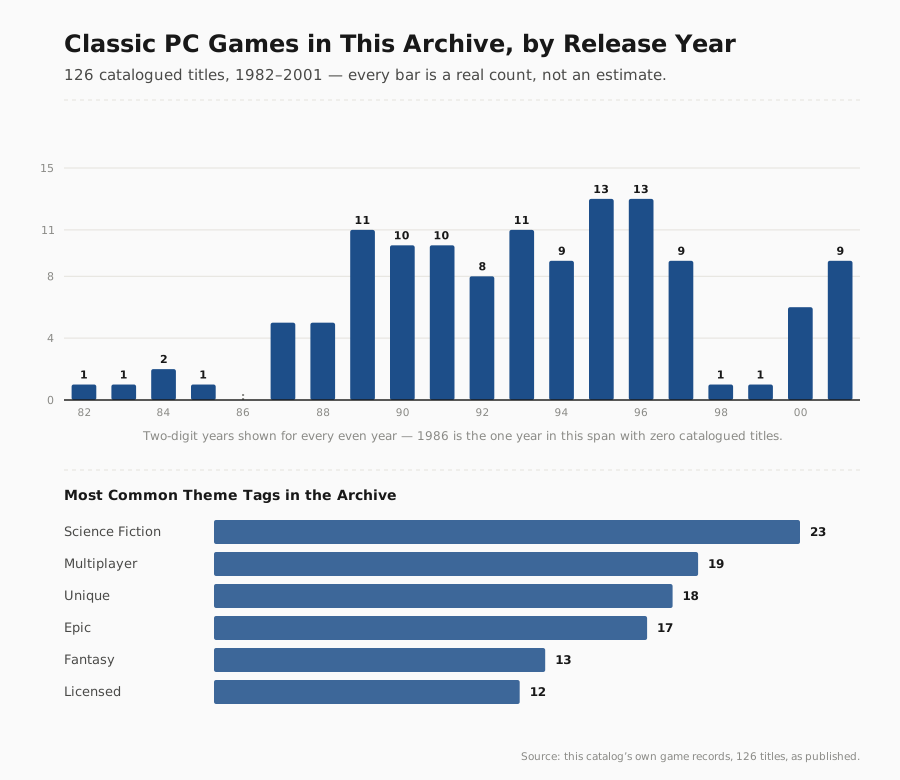
The catalog runs from 1982 through 2001: early Apple II ports, full DOS-era flight sims and strategy games, and a handful of titles that straddled the DOS-to-Windows transition at the end of the 1990s. Business simulations, naval and flight combat, cyberpunk hacking, survival adventure, and classic arcade conversions all sit inside the same classic pc games umbrella, which is exactly why theme filtering matters more here than a single flat list would.
A pc games catalog this wide also means uneven survival. Some titles have detailed credited teams, box art, and multiple contemporary reviews to draw from; others survive as little more than a name, a year, and a two-line description. Both get an honest page. Neither gets padded with invented detail to look more complete than the record actually supports.
In concrete terms: 19 separate release years, 32 distinct theme tags, and 91 credited developers and publishers currently sit inside the catalog, from single-person freeware projects to studios that shipped a dozen titles across the same decade. A handful of theme tags and companies cover a lot of ground on their own; most cover just one or two entries, which is exactly why the year and company indexes exist as their own pages instead of a single crowded sidebar.
Why This Abandonware Games Archive Skips the File Downloads Entirely
None of these classic pc games are hosted here as installers, disc images, or ROMs, and that's a deliberate line rather than an oversight. Copyright doesn't expire just because a publisher stopped selling something or shut down decades ago, and treating every old game as automatically fair game to redistribute is exactly the kind of confident-sounding shortcut this catalog is built to avoid. Where a title has landed on a legitimate modern storefront, that's noted directly on its page. Where the legal picture is genuinely murkier, the dedicated legal and safety guide covers the general question in more depth than a single disclaimer line ever could.
That separation, history and review here, sourcing questions there, is also what keeps this from becoming just another abandonware pc games download index with review text pasted on top. The record is the product.
It's also why the trust-badge system on every page does real work instead of decorating the layout. "Official re-release" is a factual, checkable claim: the original rights-holder still sells the game today, usually on a modern storefront, and the page links straight to it. "Legacy title" means ownership is clear enough to name, but there's no active commercial version to point to. "Status unclear" is the honest fallback for everything in between, titles where the studio is gone, the publisher's history is murky, or the two simply contradict each other in the surviving record. None of the three labels is a legal opinion. They're a summary of what the record actually shows, which is the most a catalog like this one can responsibly claim.
How Deep Coverage Gets Decided Across 126 Classic PC Games
Not every entry gets the same length of treatment, and that's by design rather than inconsistency. Of the 126 titles currently catalogued, 22 have a confirmed official re-release path today, 26 are legacy titles with clear ownership but no current sale, and 78 land in the harder, more honest "status unclear" bucket, meaning the surviving record simply doesn't support a confident claim either way. A small set of titles with the deepest documented history, the clearest backlink and reader interest, and the richest source material get the fullest write-ups in the catalog. The rest still get a real, specific entry, development background, critical framing, and a genuine compatibility note, sized to how much verifiable material that particular title actually has behind it.
Browsing the Catalog by Company, Theme, and Year
Three filters cover most of what anyone actually wants when they land here already knowing roughly what they're after: the studio that made a game, the kind of game it is, and when it came out. Company pages group everything from a single credited developer, useful for tracing how a studio's output evolved release to release. Theme pages group by genre-like categories the original catalog itself used, from World Wars and Naval combat to Cyberpunk and Grand Adventure. Year pages group by release year across the full 1982-2001 span.
The full alphabetical index further down this page covers everything else: every title currently in the archive, in one place, with no pagination and no chronological feed to dig through. That was a deliberate choice. A numbered "page 2, page 3" listing buries older entries behind an arbitrary cutoff; an A-Z index doesn't.
The Highest-Priority Titles in This Abandonware Games Archive
The six titles featured directly below carry some of the deepest documented history and reader interest in the catalog, spanning stealth, flight combat, arcade racing, space simulation, historical business strategy, and survival adventure. They're a starting point, not a ranking of quality against everything else here, several less-featured entries are just as thoroughly researched.
What actually puts a title in this group isn't age or genre alone. It's a combination of how much of the original release record survived intact, how widely other sites and communities still reference the game today, and whether there's enough real material to write an accurate, specific page rather than a generic one. A 1987 helicopter sim and a 1999 horror adventure can both qualify for the same reason: not because they're similar games, but because both left enough of a documented trail to earn the fuller treatment.
What's Still Being Added to This Classic PC Games Archive
126 titles is a real classic abandonware games archive, not a finished one. The original source material this project draws from covers a far larger universe of classic pc games than any single build pass can responsibly cover at full depth, and padding out entries just to inflate a total count would undercut the accuracy standard the whole archive is built on. New titles get added once they clear the same bar as everything already published: a real, checkable development history and enough surviving material to write from rather than guess at. Anyone arriving from a specific old link and not finding the exact page yet should treat the company, theme, and year indexes as the fastest way to find the closest match in the meantime.
The same discipline applies to corrections. A trust badge, a release date, or a credited developer name gets fixed the moment better source material surfaces, rather than staying wrong because a page has been live for a while. An abandonware games archive that treats its own past entries as untouchable is making exactly the same mistake as a competitor that never verifies its claims in the first place, just later in the process instead of earlier, and just as visibly once someone actually checks.
Featured entries
- Browse by themeScience Fiction, Multiplayer, Epic, Fantasy, and 28 more theme tags
- Browse by companyStrategic Simulations Inc., MicroProse, Infocom, Impressions, and 87 more
- Browse by yearThe catalog spans 1982 through 2001
- Browse the full A-Z indexEvery title currently in the archive, alphabetically, no pagination
Full A-Z index (126 titles)
A
- A-10 Tank Killer (1989): Dynamix DOS Flight Sim Guide
- Aces of The Deep: Dynamix's 1994 U-Boat DOS Sim
- Action Stations! (1989) Naval Wargame Guide
- Advanced Civilization: Avalon Hill's DOS Trading Game
- Aladdin (1993) DOS Platformer: Virgin Interactive Guide
- Albion (1996): Blue Byte's Sci-Fi Fantasy RPG Guide
- Allied General (1996): SSI's Panzer General Sequel
- Apollo 18 (1988): Artech's DOS Space Mission Sim
- Archimedean Dynasty (1996): Blue Byte's Sub Sim
- Ascendancy (1995): The Logic Factory's Space 4X Game
B
- Balance of Power (1990 Edition): Crawford's Cold War Game
- Blood Omen: Legacy of Kain — the PC Port Explained
- Blue Ice (1995): Psygnosis' Surreal Puzzle Adventure
- Bluppo (1997): The Boulder Dash Clone Worth Tracking Down
- Breach 3 (1995): Impressions' Tactical Combat Revival
- Bridge Builder (2000): The Demo That Became a Franchise
- Buck Rogers: Countdown to Doomsday — SSI's Gold Box in Space
- Buck Rogers: Matrix Cubed (1992): SSI's Stronger Sequel
C
- Car Builder (1982): The Educational Car-Design Sim
- Carrier Command (1988): 3D Naval Strategy Ahead of Its Time
- Castle Wolfenstein (1983): The Original Nazi-Castle Escape
- Chaos Strikes Back: Dungeon Master's Tougher Sequel
- Coaster (1989): Disney's DOS Rollercoaster Design Sim
- Conquest of Japan (1992): Impressions' Sengoku Wargame
- Conquest of The New World Deluxe: Interplay's Colonial Sim
D
- Daggerfall: Bethesda's Sprawling 1995 Elder Scrolls RPG
- Darklands (1992): MicroProse's Medieval German RPG
- Dawn Raiders (1991): SoftStar's Top-Down DOS Shooter
- Defender of The Crown (1988): Cinemaware's Medieval Epic
- Detroit (1993): Impressions' Vintage Automaker Business Sim
- DinoPark Tycoon (1993): MECC's Dinosaur Business Sim
- Disasteroids 3D (2000): A Free OpenGL Asteroids Clone
- Discworld (1995): The Terry Pratchett Adventure Game
- Divi Dead (1999): C Ware's Horror Visual Novel
- DOOM 2D (2001): A Freeware Fan Recreation
- Duckman: The Legend of The Fall (1997): A Rare Adventure
F
- F-16: Combat Pilot (1989): Digital Integration's Debut
- Falcon 3.0 (1991): The Flight Sim That Set the Benchmark
- Falcon AT (1988): The Overlooked Falcon Prequel
- Falcon's Eye (2001): A Graphical Front End for NetHack
- Fatal Racing (a.k.a. Whiplash): Gremlin's Stunt Racer
- Flight of The Intruder (1990): Rowan's Vietnam Combat Sim
- Football Glory (1995): Croteam's Soccer Debut
- Fragile Allegiance (1997): Gremlin's Asteroid-Mining 4X
- Frontier: Elite 2 (1993): David Braben's Elite Sequel
G
- Gary Grigsby's Pacific War (1992): Command the Fleet
- Gary Grigsby's War in Russia (1993): Eastern Front
- Gengkhis Khan 2 (1991): KOEI's Mongol Strategy Epic
- Gunship (1987): MicroProse's Apache Helicopter Sim
- The Games: Winter Challenge (1991): Multi-Event Ski Sim
- The Godfather (1991): US Gold's Movie Tie-In Misfire
I
K
L
- Laser Squad (1992): Julian Gollop's Game Before X-COM
- Leather Goddesses of Phobos 2 (1992): Infocom's Misfire
- Little Big Adventure 2 (1997): Twinsen's Odyssey Explained
- Little Computer People (1987): An Early Virtual Pet
- Little Fighter 2 (2001): Free 8-Player Beat-'Em-Up
- The Legend of Kyrandia (1994): Westwood's Fantasy Trilogy
M
- M.U.L.E. (1984): The Multiplayer Game That Shaped a Genre
- MacArthur's War (1990): SSG's Korean War Wargame
- Machiavelli The Prince (1993): Renaissance Trading Empire
- Mad TV (1991): The TV Station Sim Europe Loved
- Mageslayer (1997): Raven's Overhead Dungeon Hack
- Master of Magic (1993): SimTex's Buggy Fantasy 4X
- Master of Orion (1992): The 4X That Set the Template
- Mean Bean Machine 2000: A Fan-Made Puyo Puyo Clone
- MegaTraveller 2 (1991): Quest for the Ancients
- Microsoft Space Simulator (1994): Fly Real Spacecraft
- Mobility (2000): The Traffic Sim Built With Real Research
P
- Pacific General (1997): Naval Combat Joins the 5-Star Engine
- Panza Kick Boxing (1990): A Rare Thai Boxing Sim
- Panzer General II (1997): The Sequel of the Century
- Pizza Tycoon (1994): The Mafia Pizza Empire Sim
- Pontifex (2001): The Bridge Builder Sequel, Explained
- Princess Maker 2 (1996): Raise a Daughter, Shape Her Fate
- Psycho (1988): The Adventure Game Named After Hitchcock
- Pyro 2 (1990): The Freeware ASCII Arson Game
R
S
- Sango Fighter 2 (1995): Three Kingdoms Fighting Game
- Scorched Earth (1995): The Definitive Artillery Game
- Screamer (1995): The Arcade Racer That Beat Daytona USA
- Shadow President (1994): Run the World as U.S. President
- Shufflepuck Café (1989): Sci-Fi Air Hockey on DOS
- Silent Hill 2 Abandonware: A Classic PC Review and History
- Silent Hunter (1996): SSI's WWII Submarine Sim
- SimAnt (1989): Maxis's Ant Colony Simulation Game
- Sopwith 2 (1985): The Biplane Game That Started a Genre
- SSN-21 Seawolf (1994): EA's Modern Sub Simulation
- Stunts (1990): The Driving Game Built Around Its Editor
- Summer Games 2 (1987): Epyx's Sharper Sports Sequel
- Super Hang-On (1987): SEGA's Arcade Bike Racer on DOS
- Superhero League of Hoboken (1994): Meretzky's Comedy RPG
- Supremacy a.k.a. Overlord (1993): Chess in Space
- Sword of the Samurai (1992): MicroProse's Honor System
T
U
W
- Warhammer 40K: Final Liberation (1997) Reviewed
- Wasteland (1989): Interplay's Post-Apocalyptic RPG
- Weird Dreams (1990): Rainbird's Surreal Puzzle Game
- Wilderness (1984): A Survival Adventure Sim
- Windsurf Willy (1989): A DOS Windsurfing Simulator
- Wing Commander: Privateer (1993): A Freelance Space Sim
- Wolf (1995): Sanctuary Woods' Wildlife Simulation Game
Abandonware games: common questions
What is this abandonware games archive?
It's an editorial catalog covering the development history, critical reception, and current legal/compatibility status of classic PC games, most of them decades out of print. It documents software history as writing, not as downloadable files.
Does this site host abandonware pc games for download?
No. Nothing here is a file archive. There are no installers, ROMs, or disc images anywhere on the site, only reviews, history, and pointers to legitimate modern re-releases where one exists.
Is downloading abandonware games actually legal?
It depends on the specific title, and there's no blanket answer. The dedicated legal and safety guide covers this in detail rather than trying to compress it into one FAQ answer here.
How were these particular classic abandonware games chosen?
Priority went to titles with a real, documented history and enough surviving material to write an accurate record from: original release credits, development background, and genuine critical reception, not just a name and a box-art thumbnail.
How is the catalog organized?
By company, by theme, and by year, plus a full alphabetical index on this page. Every entry sits at most two clicks from the homepage no matter which path you browse in from.
What does a game's trust badge actually mean?
"Official re-release" means the original rights-holder still sells it today. "Legacy title" means ownership is clear but no current official version exists. "Status unclear" means the record genuinely doesn't support a confident claim either way, and the page says so rather than guessing.
Why do some entries get a full write-up and others a shorter one?
Depth follows how much verifiable history and backlink-documented interest a title actually has. A handful of titles with the deepest histories get the fullest treatment; the rest still get real, specific coverage rather than a filled-in template.
Are more classic PC games being added to the archive?
The catalog is a living project. Titles with genuine surviving documentation get added as they clear the same accuracy bar as everything already published.
Is this the original Home of the Underdogs site?
This catalog continues the identity and subject matter, rebuilt as a current editorial project. It's written in the third person throughout and makes no claim to be an unbroken continuation of any specific past team or era.
What if a game I'm looking for isn't in the archive yet?
Coverage is expanding, not fixed. If a title genuinely isn't here yet, the company, theme, and year indexes are the fastest way to check for something closely related in the meantime.